Creativity is a foundation for students to develop their problem-solving skills. Design education is one way that teachers can foster student’s creativity (Wong & Siu, 2011). Design based thinking includes fundamental thinking skills which can be used in everyday life and need to be engaged with, if learning is to be authentic as well as instructional. These include analytic, practical, creative, critical and divergent thinking skills (Sternberg, 2006). There are five stages of the design process that are vital for understanding in learning, which include discovery, interpretation, ideation, experimentation and evolution (IDEO, 2012).
3D printing is one tool that encourages the student to engage a number of these skills. 3D printing allows the user to create a three-dimensional item from a digital creation. It is both interactive and engaging for the students as it offers them an opportunity to create and construct their own designs, while also experimenting and learning from their errors, which fosters creativity (Wong & Siu, 2011). Depending on a student’s level of understanding, they have the ability to create a model from scratch, or use a scaffold which can be provided, thus providing differentiation within the classroom. They are powerful machines that can be used in a variety of KLAs, include Maths and Science, to create shapes and models and in the Creative Arts to design individualised projects (Makino, et al., 2018). Tinkercad is one example of a website where students are able to design an object to be printed. Tinkercad is an easily operated app that lets you design using shapes on a blank page which can be 3D printed.
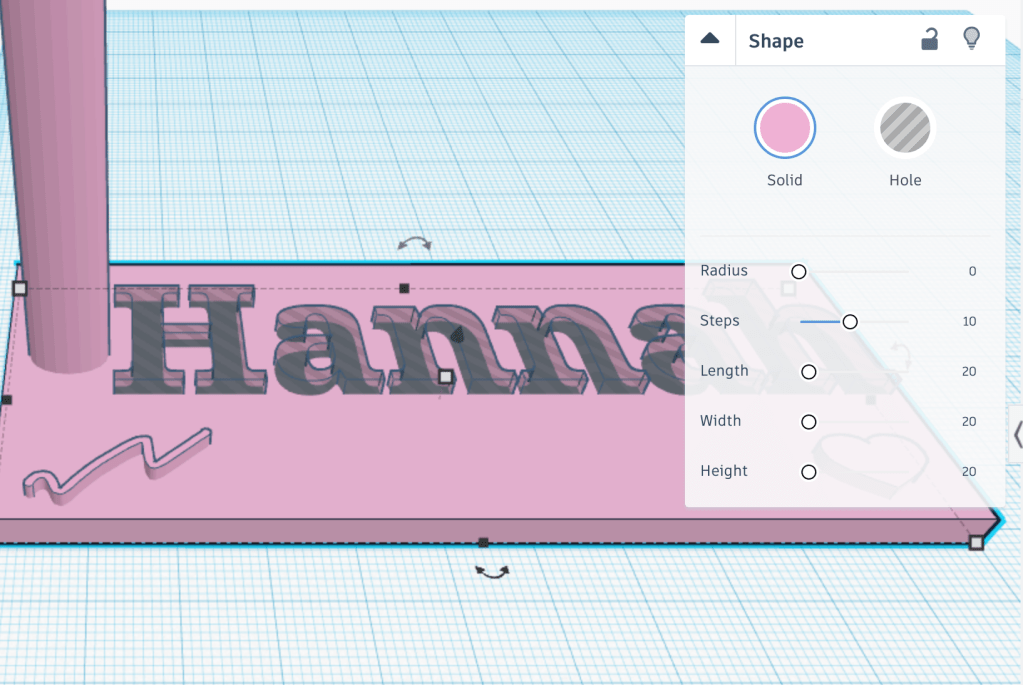
There are some limitations of using 3D printers in the classroom. 3D printers are expensive, meaning there is an inequality between students/schools who can and cannot access this technology. The teacher’s role in the classroom is also vital to facilitate learning, and they need extensive training and knowledge on how to use a 3D printer (Stevenson, et al., 2019). They also need to be confident and willing to use and model the 3D printer in the classroom, as some teachers may be worried about their own level of understanding and therefore not use the printers to their full capacity. In this case, using applications that are easily operated, such as ‘Sketchlot’, to interact with design thinking may be more appropriate. If teachers use this technology the right way, they will inspire a classroom of students and create a learning environment that is not only instructional but inspirational (Lenoir, 2006).
3D printers in the classroom can either engage students, or distract them, as they become excited or disengaged, so it is fundamental that students are provided with scaffolding and skills to utilise the equipment to its fullest potential.
References
IDEO (2012). Design Thinking for Educators (2nd Edition)
Lenoir, N. (2006). Biotechnology, Bioethics and Law: Europe’s 21st Century Challenge. The Modern Law Review, 69(1), 1-6
Makino, M., Suzui, K., Takamatsu, K., Shiratori, A., Saito, A., Sakai, K., and Furukawa, H. (2018). 3D printing of police whistles for STEM education. Microsyst Technol 24, 745-748.
Sternberg, R. J. (2006). The nature of creativity. Creativity research journal, 18(1), 87.
Stevenson, M., Bower, M., Falloon, G., Forbes, A., & Hatzigianni, M. (2019). By design: Professional learning ecologies to develop primary school teachers’ makerspaces pedagogical capabilities. British Journal of Educational Technology, 50(3), 1260-1274.
Wong, Y., & Siu, L. (2012). A model of creative design process for fostering creativity of students in design education. International Journal of Technology and Design Education, 22(4), 437-450.
 Hannah's Blog