Computational thinking is a problem-solving process (Wing, 2006). It includes analysing, organising data, interpreting patterns, implementing algorithms and breaking down each step to solve a problem, so that a computer, or human can implement an effective solution (NESA, 2017). This blog post will explore the potential of computational thinking in the classroom, and focus on the case study ‘Blockly’, which can be implemented to teach students computational thinking while also fostering creativity.
Blockly is a library of games that allow the user to build a code that runs them. Students are exposed to the fundamentals of coding, including conditionals, loops, equations, functions and code-based language (Morgan, 2014).
Case study
One game that runs on the blockly site is ‘Maze’. Students are given levels of mazes to navigate their character through, by developing their own codes. Each level becomes more complex as students begin to develop the basic skills needed for coding.
Blockly can be used in the classroom to develop students computational thinking gradually through challenging students, while also fostering creativity as students develop skills as they find their own ways to progress through levels. Using blockly helps students develop higher order thinking skills such as analysing, implementing algorithms and breaking down problems, which are also transferable skills that can be applied to other knowledge areas (KLAs) and used in everyday life (Hsu, 2018). This would be useful in a Maths class as Blockly could be used to encourage students to use their new problem-solving skills to create and solve a digital algorithm. By learning these skills, students become active participants, more confident in their abilities, leading to higher self-esteem (Lawrence, 2006).
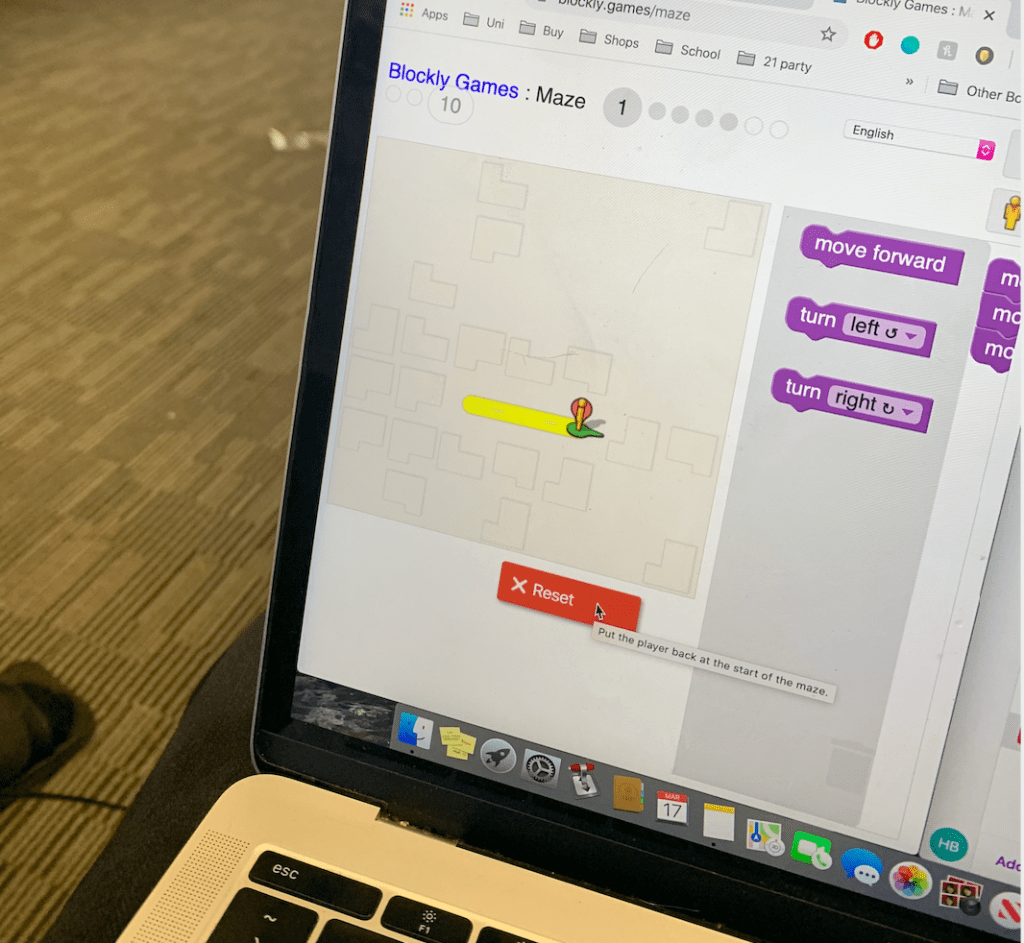
However, Blockly has its limitations. Students are not able to create their own solutions to the levels, as there is only one answer, reducing the freedom of creativity. It also has limited power once student’s arrive at certain levels as these levels may become too difficult to overcome, even with the teacher’s help. Blockly can also be quite difficult to navigate for students in the earlier stages. There are other websites that have utilised Blockly JavaScript coding in a more user-friendly way that can implement creativity more effectively, for example, micro:bit. This programme allows the user to implement their own solutions to create a game like scissors, paper, rock.
Both of these technologies need to firstly be modelled and scaffolded, then as students become more familiar with the technologies, the teacher is then able to guide students when necessary until students are able to interact with these technologies alone. Overall, these technologies would both work well together in a classroom to learn computational skills, and link to other KLAs, by using a hands-on approach to learning.
References:
Hsu, T. C., Chang, S. C., & Hung, Y. T. (2018). How to learn and how to teach computational thinking: Suggestions based on a review of the literature. Computers & Education, 126, 296-310.
Lawrence, D. (2006). Enhancing self-esteem in the classroom. Pine Forge Press.
Morgan, N. (2014). JavaScript for kids: A playful introduction to programming. No Starch Press.
NESA (2017). Science and Technology K-6 Syllabus. Available at: http://educationstandards.nsw.edu.au/wps/portal/nesa/k-10/learning-areas/technologies/science-and-technology-k-6-new-syllabus
Wing, J. M. (2006). Computational thinking. Communications of the ACM, 49(3), 33-35. Available from: http://dl.acm.org.simsrad.net.ocs.mq.edu.au/citation.cfm?doid=1118178.1118215
 Hannah's Blog
Hey Hannah!
Great insight into blocky, especially the comparison between the positive and negative! I have to agree that Blocky might be quite difficult to navigate in the early stages, because I also had some trouble trying to figure it out. I agree that Blocky reduces creativity, but I believe it opens students to high-level thinking. Don’t you agree? I would be astounded if my student had completed all 10 levels without any help.
After reading your blog, it made me think, do you think Blocky would be a good application for long-term learning, or do you think of it as a one-off learning experience for students?
Keep up with the good blogs!
Ann
LikeLike
Hi Ann! Thank you for your feedback
I agree that Blockly can be engaging for students in the classroom, and allows students to use and gain their higher order thinking skills, however, creativity is important for the use of emerging technologies in the classroom, and Blockly does not provide student’s with this in-depth skill.
Blockly would be great to have as a long term activity in the classroom, as each challenge is harder, students are provided with intrinsic motivation to complete the levels, which also results in them extending and challenging themselves. This can lead to higher self-efficacy and more motivation in the classroom which I think is important for students to gain.
Thankyou for your insightful comment
LikeLike