Augmented reality is the addition of a computer-assisted contextual layer of information over the real world, creating an enhanced reality (Kapp & Balkun, 2011). Pokémon Go which overlays characters into the world around the user is an example of AR. Augmented Reality has the capacity to greatly influence students learning in the classroom, by promoting a creative learning environment where they are able to discover and submerge themselves in experiences, usually beyond their physical reach. An example of this could be conducting hazardous science experiments without fear of being harmed (Siegle, 2019). AR allows students to play with and model 3D objects on a screen. It also allows students to learn and innovate, increase their knowledge retention and reduce their cognitive load (Mehta, 2012).
Case study
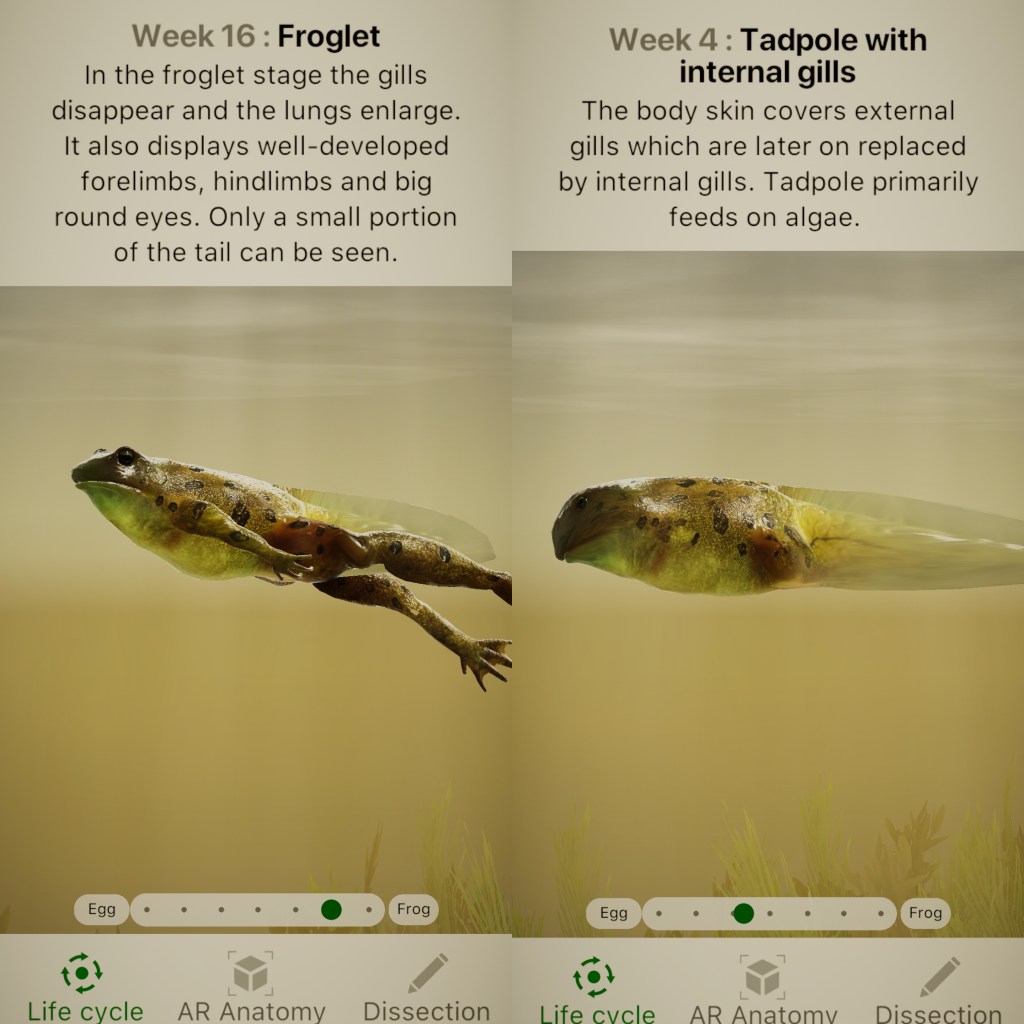
‘Froggipedia’ is one example of AR that can be used in the classroom. It allows students to observe and interact in a frog’s life cycle. Students are able to place a real frog on their desk and explore the frog’s systems e.g. muscular, skeletal and digestive (Siegle, 2019). There is a dissection feature where students can dissect the frog without mess but with the same results, the app even alerts the user when they aren’t being careful with the scalpel. It is an interactive and simple way to engage students in the science syllabus e.g. outcome “ST2-4LW-S “compares features and characteristics of living and non-living things”. This app allows students to learn through “inquiry-based learning” as students manipulate the frog on their screen and help foster their creativity through collaboration by sharing insights with peers (Bower, 2014).
It is a promo video which details all the different features of ‘Froggipedia’
However, there are some weaknesses of using ‘Froggipedia’ which include the lack of species variety, as there is only one species of frogs to be explored. This doesn’t represent the anatomy or life cycle of other species of frogs. Additionally, frogs are the only animal that can be explored and for students to have a detailed understanding of a life cycle/dissection, this app should include the ability to explore other animals, which may limit student’s creativity. Teachers need to be equipped with the skills to use these new apps, so they can teach students innovatively and also problem solve when there are technological difficulties, ensuring the class does not spend too much time learning how to use the app, rather than actually interacting with it. ‘Sandbox’ is another AR design that schools can use to teach KLAS. It allows students to explore the concept of erosion without leaving the classroom.
AR apps can have many benefits in the classroom, as the apps enable students to create interactive products that demonstrate and enhance their learning. They are able to engage with a variety of subject matters and as well as interact with the environment without actually leaving the classroom. Such a resource is invaluable to schools that may lack resources but with these apps they are able to more than compensate for this, providing students with a world of exploration and discovery.
References
Bower, M., Howe, C., Mccredie, N., Robinson, A., & Grover, D. (2014). Augmented Reality in education – cases, places and potentials. Educational Media International, 51(1), 1-15.
Kapp, C., & Balkun, M. M. (2011). Teaching on the virtuality continuum: Augmented reality in the classroom. Transformations: The Journal of Inclusive Scholarship and Pedagogy, 22(1), 100-113.
Mehta, V. (2012). Restructuring 2D Objects in 3D World Using Augmented Reality-Based Future Classroom. IUP Journal of Computer Sciences, 6(2).
Siegle, D. (2019). Seeing Is Believing: Using Virtual and Augmented Reality to Enhance Student Learning. Gifted Child Today, 42(1), 46-52.
 Hannah's Blog
Hi Hannah,
You have given a great overview of augmented reality! I can tell you have also explored apps other than froggipedia (Pokemon go and sandbox) which would have aided in your understanding. How do you feel these apps compare to froggipedia as an educational tool?
It is great that you have linked the technology to a specific outcome, it has really enhanced your argument. Do you feel the outcome is better achieved with augmented reality than textbooks/ models ect?
I also wonder what your opinion is regarding the ability of froggipedia to foster creativity?
LikeLiked by 1 person
Hi Rebecca! Thanks for your comment. I would say each app has it’s strengths and it definitely depends on the KLA focus of the class as to what app works best. Froggipedia as an educational tool would be best used in science to explore living things, where as Pokemon go would fit the best into the technology aspect of the S&T syllabus.
I definitely believe AR allows student’s to think more creativity, deeper and engage more on the concept that using textbooks and questions as this only focuses on lower cognitive skills such as understanding
As mentioned in the introduction of the blog, the main way this app allows student’s to foster their creativity is by exploring and emerging themselves into the experience of dissecting a frog. Students will all come up with different ideas and thoughts after the virtual disection.
Thanks for your comment, definitely helped me to think more into the topic!
LikeLike
Hi again!
I totally agree AR has the potential to allow for creativity but I found froggipedia to be one of the less creative AR apps (focusing on the AR section). It brings the frog to life but you can not really do much but read the information text, rotate and zoom. What is your opinion?
LikeLike
I do agree in terms of exploring the frog, however it has the potential to expand student’s creativity by allowing the students to explore the different life cycles of the frog and create different activities which focus on these particular life cycles. An example would be designing a Kahoot or Popplet on the different systems and integrating them together in their own creative style.
I believe this app has the most potential for creativity with its use of the dissection tool that allows students to engage and investigate this concept for the first time and also explore the features of the app, then ask student’s to elaborate on their findings before providing formative assessment.
LikeLike
Yeah, I get what you mean! I guess the main take away is that it is up to the teacher to use the app creatively. It should be used in conjunction with an activity to give the exploration purpose and to understand how the student is performing. Would you agree?
LikeLike
I would agree. Thankyou for your feedback and insights, I learnt alot of new things!
LikeLike
Hi Hannah,
Thank you for your insight in to Froggipedia, as well as Sandbox. You have provided a well rounded argument, which has made me consider whether or not I should include Froggipedia in to my own learning experiences with the children I will teach in the future. It is clear how it could be a technology that could quite easily be incorporated in the the Science classroom to delve in to the syllabus outcome you have outlined and how it would be beneficial to incorporate as a mess-free way to explore the dissection of frogs and its anatomy/life cycle. However, like you have discussed, I wonder why this technology does not allow its users to explore a wide range of frog species, which would seem to be quite beneficial for student understanding of frogs. I also deliberate if students would benefit more on a real-life hands on experience when dissecting animals (or in this case, frogs), because I also believe it is important for students to interacting with real-life animals to truly capture the ‘dissection’ anatomy exploration experience. Nonetheless it is a technology that I would consider incorporating in a Science lesson, as the benefits of this technology are that students can manipulate the frog and also explore the frogs life cycle in an interactive and engaging way.
LikeLike