Virtual reality (VR) is a three-dimensional, computer generated virtual environment that allows users to act in a fully immersed, real-time simulation (Southgate,2018). This blog will explore the power of VR in the classroom, including its ability to promote creativity, raise curiosity and engage students in becoming active learners, placing the power learning in their hands. It also transforms the teaching of educational content, as it enables students to not only see the content, but interact with it, bringing the lesson to life and increasing engagement (Southgate, 2018). Teachers have the ability to take students on field trips, to places that otherwise wouldn’t have been possible due to cost, danger, or time period. Students can visit other planets, or visit ancient Greece using VR (Freina and Ott, 2015). This is important as it empowers students to explore, extend and enrich their learning while fully immersing themselves in the experience, increasing intrinsic motivation and promoting empathy (Dede, 2009).

https://apps.apple.com/au/app/cospaces-edu/id1224622426 – This is the link to download the app!
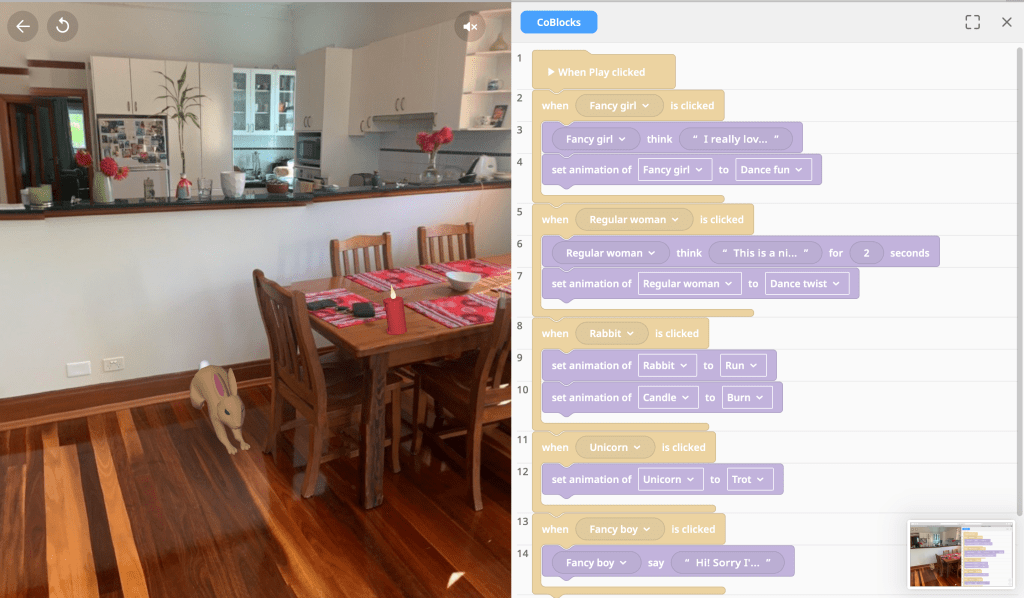
CoSpaces is an online platform, where users create 3D environments that can be viewed on a screen or in VR, using Google cardboard. This offers students ample opportunities to express their creativity, as they’re able to design the background, add sound, images, objects (people, furniture) and their own designs, promoting higher order thinking. Coding is another functionality of CoSpaces, called CoBlocks, that allows students to further their coding capabilities by enabling their objects to move or talk. Anne Frank’s house can also be on VR, where student’s are able to experience this house using Oculus VR googles.
As users have almost limitless boundaries using CoSpaces, their designs can be as creative as their mind is creative. They could build a house on the moon or design a landscape for their pet unicorns. CoSpaces can incorporate many KLAs, including English, where students could write a creative writing piece detailing the adventures their characters pursue, in their VR environments (Outcome code: En2-10C) (NESA, 2012).
There are however challenges when implementing VR. These include the cost of VR technology, as the average cost of a headsets is $400, however less expensive headsets like Google cardboard are being released (Freina and Ott, 2015). These will allow more schools to implement VR in their classrooms. Another issue is both the students and teachers need to be trained in ways to properly implement the technology, which can take further time out of the lesson. Lastly, an issue in relation to health, is students are present in the virtual environment without a ‘reality check’, so students may become motion sick, as there is no real-world experience (Davis, 2014). Students aged 2-12 are the most susceptible to cybersickness, therefore using VR technology in the classroom for too long may increase student’s likelihood of feeling physical discomfort (Davis, 2014).
Despite these limitations, VR has the potential to radically transform education, if used correctly. However, more studies and research need to be undertaken, if VR is to be used more effectively, for promoting creativity, collaboration and deep learning.
References
Davis, S., Nesbitt, K., & Nalivaiko, E. (2014, December). A systematic review of cybersickness. In Proceedings of the 2014 Conference on Interactive Entertainment, (pp. 1-9). ACM.
Dede, C. (2009). Immersive interfaces for engagement and learning. science, 323(5910), 66-69
Freina, L., & Ott, M. (2015). A literature review on immersive virtual reality in education: State of the art and perspectives. In The International Scientific Conference eLearning and Software for Education (Vol. 1, p. 133). National Defence University.
NESA – NSW education standards authority. (2012). English K-10 syllabus.
Southgate, E. (2018). Immersive virtual reality, children and school education: A literature review for teachers.
 Hannah's Blog
Hi Hannah,
This blog really highlights the affordances of CoSpaces in the classroom, I agree it really is a transformative technology. I had not thought of it being used as a virtual excursion, that’s a great idea.
The example you gave for English was really interesting too. Would you have students first create their own virtual world and then write the narrative or use the virtual world to bring their story to life? I think both would work well. I also see potential for peer assessment as students can explore their classmates’ CoSpaces, or perhaps as summative assessment as students present their narrative to the class and providing a summary of the story.
Your examples allow students to really unleash their creativity, which is great! Do you have any strategies to prompt or inspire students who may feel they simply “can’t come up with anything”?
LikeLike
Hi Brooke!
Thankyou for your insightful comments.
For the English example provided, I hadn’t thought about having students create their own virtual world first! Both have their own pros and cons, but I would have had the student’s create the virtual world first, and then write the narrative so their creativity stems from using the emerging technology of VR. The assessment idea is a great idea!!
I would provide students with some time to explore other virtual worlds before creating their own. If student’s were struggling, I would provide them with 10 topics to choose from, and while this is limiting their creativity a little, if they had no options or ideas, this provides them with some direction, while also still giving them free reign to explore and design themselves
LikeLike
Hi Hannah, I thoroughly enjoyed your blog post! You made it very clear how virtual reality could be implemented in the classroom, outlining benefits and limitations that could potentially arise when using the technology. You also clearly described how it can foster creativity within students by using the example of CoSpaces. I also used this technology in my own blog post as i believe it has the capacity to enrich learning on multiple platforms. VR is such a cool technology that i hope to see more of in future teaching!
LikeLike
I agree that CoSpaces is a great application that allows students to gain a deeper understanding of the topic. Thank you for your feedback!
LikeLike
Hi Hannah, thank you for this insightful post on virtual reality. I agree with you that VR can be a great tool to engage and motivate students as it allows a fully immersive experience. VR can take students to places thats would otherwise be impossible to visit such as volcanoes and the deep ocean. Creativity can also be fostered around VR if we as teachers design appropriate activities and provide scaffolding to those activities. Under teacher guidance, students can explore the virtual world and become independent active learners. However, VR can be very expensive as you’ve mentioned that one headset would set you back $400! Not to mention there are also other concerns (safety, usability, ethical) with using the technology. But with the use of VR still in its infancy stage, i believe it will get better in the future!
LikeLike
Hi! I agree that VR offers a-lot of affordances but also limitations that need to be discussed and addressed before being used in the classroom. The teacher needs to weigh up whether using this technology will enhance students learning, and also discuss whether it is a technology thats use can be sustained due to its price and the training for teachers needed
LikeLike